Security has become an essential part of running a business, whether it is a corporate office, manufacturing unit, warehouse, residential complex, hospital, retail outlet, or construction site. Protecting employees, visitors, equipment, inventory, documents, and physical infrastructure requires more than simply locking doors after working hours.
Today, businesses commonly rely on two major security solutions: CCTV surveillance and trained security personnel. While CCTV cameras provide continuous monitoring and recorded evidence, security guards offer human judgment, physical intervention, and immediate response.
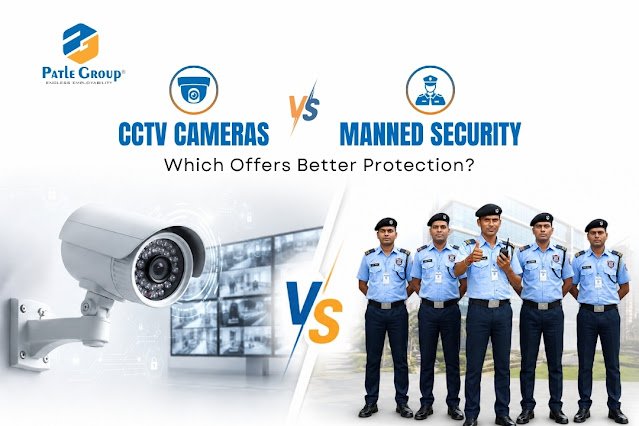
This raises an important question: CCTV vs manned security—which offers better protection?
The answer depends on the property's size, security risks, access points, operating hours, and the level of human interaction required. In many situations, combining CCTV with trained security personnel provides a stronger and more practical security system.
Understanding CCTV Security Systems
Closed-Circuit Television, commonly known as CCTV, is one of the most widely used security technologies. CCTV cameras allow businesses to monitor selected areas continuously and record activity for future review.
Modern CCTV systems can be installed indoors as well as outdoors and may include features such as:
-
24/7 video surveillance
-
Night vision
-
Motion detection
-
Remote monitoring
-
Video recording
-
Entry and exit monitoring
-
Perimeter surveillance
-
Incident recording
-
Integration with access control systems
One of the biggest advantages of CCTV is its ability to provide continuous visual coverage. A properly positioned camera can monitor an entrance, parking area, warehouse aisle, production floor, or perimeter throughout the day and night.
Recorded footage can also become valuable when investigating incidents such as theft, unauthorised entry, property damage, or disputes.
However, CCTV has an important limitation: it primarily observes and records. A camera can detect suspicious activity, but by itself it cannot physically stop an intruder, question a visitor, control access, or respond to an emergency.
What Does Manned Security Offer?
Manned security involves trained security personnel who are physically deployed at a property. Unlike cameras, guards can interact directly with people and make decisions based on the situation in front of them.
Depending on the site requirements, professional security personnel may handle:
-
Access control
-
Visitor verification
-
Gate management
-
Vehicle checking
-
Regular patrolling
-
Incident response
-
Emergency assistance
-
Suspicious activity monitoring
-
Security registers
-
Incident reporting
The physical presence of a trained guard can itself act as a deterrent. People attempting unauthorised access are more likely to reconsider when they know that security personnel are actively monitoring the premises.
This is particularly important for businesses that require regular interaction with employees, visitors, delivery personnel, contractors, vendors, or customers.
CCTV vs Security Guards: Key Difference
The most useful way to compare CCTV and manned security is to understand that they perform different functions.
CCTV is primarily focused on visibility and documentation. Security personnel are focused on observation, decision-making, communication, and action.
For example, imagine that a CCTV camera detects an unfamiliar person entering a restricted section of a warehouse. The camera can record the activity and alert a monitoring team if the system supports active alerts. However, a trained security guard can immediately approach the person, verify their identity, check their authorisation, and take action according to the site's security procedures.
Similarly, CCTV can monitor several areas simultaneously, while guards can patrol areas that may not always be visible through cameras.
This makes both solutions valuable, but for different reasons.
Which Is More Cost-Effective: CCTV or Manned Security?
Cost is an important consideration when selecting a security solution. However, businesses should evaluate the total requirement rather than comparing only the initial expense.
A CCTV system generally involves an initial investment in cameras, recording equipment, networking infrastructure, installation, storage, maintenance, and potentially monitoring software. Once installed, the system can provide long-term surveillance without requiring a guard at every location.
Manned security, on the other hand, involves recurring costs associated with salaries, training, uniforms, supervision, statutory requirements, leave arrangements, and replacement staffing.
However, the cheapest option is not necessarily the most effective one.
A warehouse with multiple access points may need both cameras and guards. A small office with controlled access may require a different approach. Similarly, a high-value industrial facility may need multiple layers of protection because the consequences of a security failure can be significant.
Therefore, businesses should evaluate risk, property size, access points, operating hours, asset value, and human interaction requirements before selecting a security model.
When Is CCTV More Suitable?
CCTV can be highly effective when a business needs continuous visual monitoring across multiple areas.
It can be particularly useful for:
-
Warehouses
-
Manufacturing facilities
-
Parking areas
-
Corporate offices
-
Retail outlets
-
Storage facilities
-
Residential complexes
-
Building perimeters
Cameras are especially useful where deploying security guards at every point would be impractical.
For example, a large warehouse may have several aisles, loading areas, storage sections, and external boundaries. CCTV can provide broad visibility across these locations while reducing the need for physical deployment at every individual point.
However, businesses should pay attention to camera placement, lighting conditions, recording capacity, system maintenance, network connectivity, and monitoring arrangements. A poorly planned CCTV system may leave blind spots and reduce the overall effectiveness of surveillance.
When Is Manned Security More Suitable?
Manned security becomes particularly important when a location requires human interaction, physical access control, or immediate decision-making.
Security guards can be valuable for:
-
Corporate offices
-
Industrial plants
-
Construction sites
-
Schools and colleges
-
Hospitals
-
Hotels
-
Shopping complexes
-
Residential communities
-
High-value storage facilities
-
Events and large gatherings
At these locations, security involves more than watching a screen.
A guard may need to verify visitors, inspect vehicles, manage deliveries, control entry and exit, guide people during emergencies, monitor suspicious behaviour, and communicate with management.
For busy commercial and industrial properties, this human element can make a significant difference.

Why CCTV and Security Guards Work Better Together
For many businesses, the strongest approach is not choosing between CCTV and security guards. Instead, it is creating a combined security system using technology and trained manpower.
CCTV can extend the visibility of the security team. Guards can provide the physical response that cameras cannot.
For example, cameras can monitor a large perimeter while security personnel conduct physical patrols. If suspicious activity is identified through CCTV, guards can investigate the situation immediately.
This creates multiple layers of protection.
The combination can also help security teams work more efficiently. Instead of physically monitoring every location at all times, guards can use surveillance technology to identify areas requiring attention.
In this model:
CCTV provides visibility.
Security personnel provide judgment.
Security procedures provide direction.
Together, they create a more responsive security system.
Why Trained Security Personnel Matter
Hiring security guards is not simply about placing someone at the entrance. The quality, training, discipline, supervision, and site knowledge of the security team can directly influence the effectiveness of the security arrangement.
Professional security personnel should understand access control, visitor management, emergency procedures, communication protocols, basic safety practices, patrolling, and incident reporting.
They should also receive proper briefing about the specific property they are protecting.
For this reason, businesses should consider the training and supervision practices of a security provider before making a decision. A well-trained guard who understands the site's procedures can respond more effectively than an untrained person simply assigned to watch an entrance.
Why Businesses Choose Professional Security Services in Nagpur
Managing security internally can become challenging for businesses operating multiple shifts or large facilities. Recruitment, attendance, training, replacement staff, uniforms, supervision, documentation, and daily coordination require continuous attention.
Professional security agencies can help businesses manage these operational responsibilities by providing trained personnel according to the requirements of the site.
For organisations looking for reliable security services Nagpur, selecting an experienced provider can make it easier to establish structured security procedures rather than depending on individual guards without proper supervision.
Patle Group for Professional Security Guard Services in Nagpur
Patle Group focuses on security solutions designed around the practical requirements of different businesses and properties. Security requirements are not identical for a corporate office, industrial unit, warehouse, residential complex, or construction site.
A professional approach considers factors such as the property's layout, access points, workforce, assets, operating pattern, and potential security risks.
Patle Group provides security services Nagpur with an emphasis on trained manpower, discipline, supervision, access control, and site-specific requirements.
By combining trained security personnel with appropriate technology and systematic security procedures, businesses can establish a more responsive and organised security environment.
CCTV or Manned Security: Which One Should Your Business Choose?
There is no single solution that is ideal for every business.
CCTV is stronger for continuous observation, remote monitoring, recording, and incident documentation.
Manned security is stronger for physical intervention, access management, human judgment, communication, and immediate response.
For a relatively low-risk property, CCTV may provide adequate surveillance when properly installed and monitored. For high-risk premises, trained security personnel may be essential.
For many commercial, residential, and industrial properties, the most practical option is a combination of both.
The decision should therefore be based on risk assessment rather than technology preference.
Conclusion: Build a Layered Security Strategy
CCTV and manned security should not necessarily be viewed as competing options. They are complementary layers of protection.
Cameras provide visibility and recorded evidence, while trained security personnel provide judgment, communication, physical intervention, and immediate response.
Before choosing a security solution, businesses should assess their property size, operational activities, access points, working hours, asset value, visitor movement, and potential risks.
For organisations seeking dependable security guard services Nagpur, working with an experienced provider such as Patle Group can help create a practical security strategy that combines trained manpower, supervision, security procedures, and technology where appropriate.

Ultimately, effective security is not simply about detecting a problem. It is about creating a system capable of identifying risks, responding quickly, protecting people and assets, and reducing the possibility of repeated incidents.
Contact Patle Group :
Website : https://patlegroup.com/
Mobile Number : +91 7420888699
Address : Patle Group In front of Corporation School, Jaitala, Nagpur - 440036